
Through this guide, you are about to discover one of the most important guitar collections in the world, and the history of one of the most outstanding instruments of Spanish culture.
Casa Sors is a family business that was founded in 1972, by Fernando Alonso Mercader (1945-2021), guitar player and tango singer.
Fernando Alonso Mercader was born in 1945 in Barcelona. From a very young age he entered the world of music as a tango singer, using the guitar to accompany himself.
At the age of twelve he began his public performances, alternating this activity with music studies at the Municipal Conservatory of Barcelona.
At the age of 18 he is requested by the Argentine Embassy and different consulates, accrediting as one of the best tango voices of the moment. He performed several times on TVE and wins several awards. He signed a contract in Madrid, with SONOPLAY.
When it seemed that the triumph is near, a pulmonary affection prevents him from fulfilling his commitments.

He studied with several renowned guitarists with whom he became friends, among them Elio Llorens, Emilio Pujol and Eduardo Sainz de la Maza. He founded Casa Sors in 1972, when he was 27 years old. He then created a musical nucleus, centered on the guitar, frequented by internationally renowned musicians from all over the world.
He also dedicates a great part of his activity to the exaltation of the guitar and to the historical-artistic divulgation, preserving figures of Spanish musicians, among them Miguel Llobet, Francisco Tárrega, Fernando Sor, and many others. In 1977 he celebrates a concert in homage to Miguel Llobet, in the Palau de la Música Catalana in which Maria Luisa Anido participates. In 1978 he manages to gather all the personal documentation and the guitars of Miguel Llobet.
In 1990, while trying to transcribe for guitar a work by Oudrid, he invented the key system, expanding the possibilities of the six-string guitar. After the invention of the Guitarra de Llaves, the name he gave to his new instrument, he made several transcriptions of classical themes and also versions of popular themes, all of them very celebrated by guitarists due to his particular way of harmonizing and orchestrating on the guitar.
manages Casa Sors and maintains his father’s legacy. His work has transformed Casa Sors, creating a multifunctional space, thus becoming a cultural reference in Barcelona and the world.
Sator is a leading figure in the world of classical guitar and Spanish music, whose professional career is marked by passion, self-improvement and a deep love for the musical art. His career not only reflects his respect for the legacy of his father, Fernando Alonso Mercader, but also his innovative vision and commitment to the preservation and dissemination of musical heritage.
From a young age, Sator grew up surrounded by music under the guidance of his father.
Fernando Alonso dreamed of creating an authentic “nest of art”, a place where music, teaching and performance coexist in harmony. After his passing, Sator fulfilled his father’s dream by expanding Casa Sors, opening a new and spacious venue, where he currently runs the institution.
Casa Sors has grown remarkably under Sator’s direction, becoming a vibrant cultural center, hosting concerts and flamenco shows, with renowned artists and classical guitar recitals offering unique experiences to attendees.
One of the highlights of Sator’s work is his respect for the history of musical instruments and his passion for maintaining them in their most original state. Over time, he has amassed one of the most impressive collections of historic guitars in the world. Diego has taken his love of history and the guitar beyond the physical, creating a popular YouTube channel with an international audience.
A key moment in his artistic career was his participation as a musician in the reconstruction of the orchestra Lira Orfeo in 2016 and 2017, under the direction of Carles Trepat, using the original instruments of the orchestra, in which, in addition, Casa Sors actively collaborated.
Another of the most significant achievements of his career has been the revitalization of the use of gut strings, an organic material that, thanks to his dedication, has once again become available to contemporary guitarists.
His work has achieved repercussion in media such as *Forbes* and *La Vanguardia*, where his contribution to musical culture has been highlighted.
The guitar is a musical instrument whose origin is uncertain, although what can be affirmed is that it is an instrument that is developed and established in Spain, in the baroque period, becoming the popular instrument, which is extended and known as Spanish guitar. So although we cannot claim the invention, we can attribute the development and standardization of the instrument to Spanish Culture.
The origins of the guitar are not very clear, as numerous similar instruments were used in ancient times. Some of the theories of the invention of the instrument are:
The first instrument we have is a original Baroque Guitar. This beautiful guitar was built in 1769, in Seville, southern Spain, by Francisco Sanguino.
This guitar is one of the oldest in the world and holds a unique place in history, as only five of its kind exist today. This guitar stands out not only for its rarity but also for its exceptional craftsmanship and design.
This 12-string guitar (featuring six double strings) is larger than typical guitars, with a notably wide body that resembles a double guitar, producing a profoundly deep and powerful sound.
Unlike modern guitars, this instrument has only 12 frets, with 9 being particularly functional, which influenced the musical compositions of its era.
The absence of a fingerboard adds to the complexity of playing it, demanding a higher level of skill from the musician. The intricate decorations are meticulously handcrafted using luxurious materials such as ivory and mother-of-pearl, showcasing the artistry that went into its creation.
Inside the guitar, the label reads in Latin:
This inscription not only authenticates the instrument’s age and origin but also adds to its historical and cultural significance.
The baroque period is characterized by: Appearance of tonality, a system of harmonic organization that is still in use today, use of the basso continuo, use of musical ornaments (such as trills and mordets) to embellish the melody and a wide variety of tonalities and modes to express different emotions. Some of the outstanding musicians are: Gaspar Sanz and Santiago de Murcia.
Casa Sors Museum has unpublished material of incalculable value for guitar and music lovers. Among its most outstanding treasures are manuscripts by Miguel Llobet, as well as paintings by Llobet, who in addition to being a virtuoso guitarist, was a talented painter in his youth.
Also on display are never-before-seen postcards documenting the friendship and mutual admiration between Llobet and composer Manuel de Falla, a testament to the rich relationship between two key figures in Spanish music.
In addition, the museum houses original manuscripts of great guitarists and composers, concert programs, extensive library of scores, books and methods, original gut and silk strings from the early 20th century, as well as the tools that belonged to the legendary luthier Francisco Simplicio, one of the most important guitar craftsmen of his time. These pieces, along with many others, enrich the historical and cultural value of the museum.
The Casa Sors Museum houses a large collection of historical methods, which not only helped to train generations of guitarists, but are also valuable testimonies of the musical trends of each era and the evolution of the technique and teaching of the instrument over the centuries.
Among the most important methods that can be found in the Museum are:
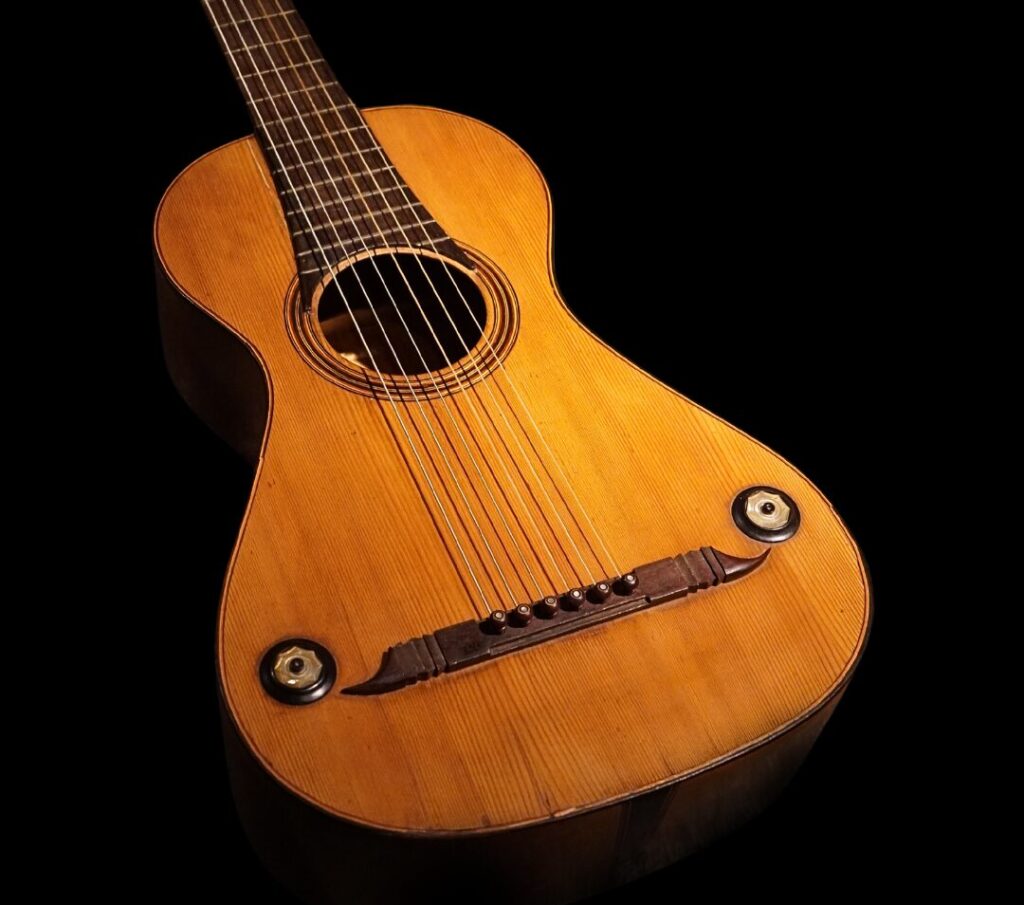
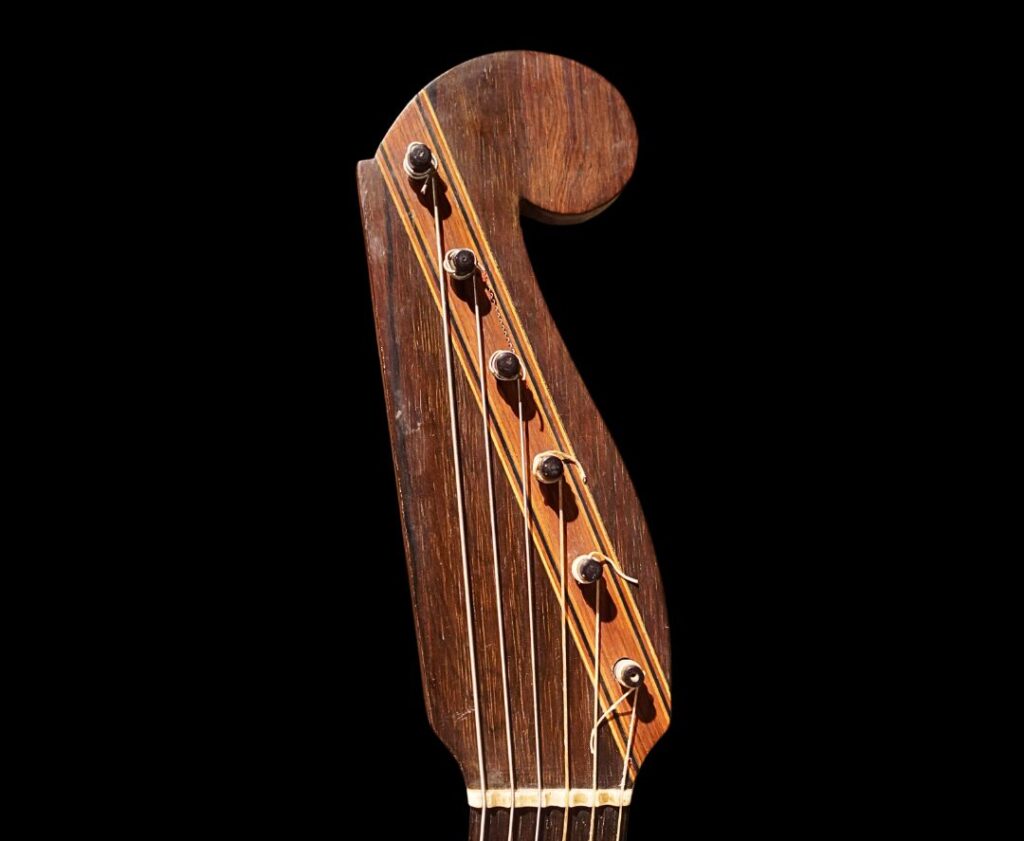
The romantic guitar is distinguished by its smaller size, characteristic of guitars from the first half of the 19th century.
This period saw significant developments in guitar design and craftsmanship, particularly influenced by the Cádiz school from the south of Spain. This tradition left a lasting impact on guitar making globally, inspiring even renowned brands like Martin in the United States.
One of the most notable innovations of this era was the introduction of the fingerboard, a crucial element that set a precedent and influenced all subsequent luthiers. The addition of the fingerboard significantly enhanced playability and precision, allowing for more complex and expressive performances.
This period also saw the consolidation of the single-string format, leading to the standardization of the six-string guitar, which remains the norm today.
Moreover, the romantic guitar featured an increase in the number of frets, expanding the instrument’s range and versatility. The internal bracing of the guitar was also improved during this time, providing better structural support and contributing to a richer, more resonant sound.
These advancements not only defined the romantic guitar but also laid the groundwork for the modern classical guitar, influencing its design and construction for generations to come.
Romanticism has musical characteristics such as: Emotional expressiveness, lyrical melodies (more singable and expressive), free rhythms and harmonic coloring (rich and varied harmonies, with frequent use of modulations). Some of the outstanding musicians are:
The modern guitar is divided into two types of guitar: Classical Guitar and Flamenco Guitar. There are many differential elements between one and the other, but possibly the most outstanding are these three:
The action is understood as the distance between the strings and the fretboard.
When there is a lower action, as in the case of the flamenco guitar, there is less distance, so it is easier for us to play, and therefore we can go faster. It also allows us to make «cerdeos» which is known in the guitar as a technique that produces a noise when a string vibrates against one of the frets of the guitar instead of sounding freely.
Classical guitars usually have a higher action, so there is more distance, producing an amplification of the volume of the guitar, but at the same time, being more complicated to play
A protective piece that is placed on the tops of flamenco guitars, helps protect the guitar’s delicate wooden top from the percussive finger tapping and strumming that are characteristic of flamenco music.
Without it, the continuous striking of the fingernails could damage the instrument’s surface, leading to scratches, dents, or even more severe wear over time.
It can be made from one or two separate pieces. The material used for these protectors varies, with the most common options being thin sheets of plastic or wood.
Mostly used in flamenco guitars, although sometimes we see it in classical guitars.
Traditionally, flamenco guitars have been built with typical Spanish woods, and classical guitars with imported woods. Therefore, normally, it used to be more complex to acquire a classical guitar, due to the complexity to acquire woods, and also because of the high price of the guitars.
Among the woods used, some of the most notable include:
For Flamenco Guitars: Spanish cypress, which contribute to the bright, percussive, and sharp tone that characterizes flamenco music.
For Classical Guitars: Brazilian Rosewood and Maple, which help produce the warm, resonant, and balanced sound desired in classical music.
The Stradivarius of the Guitar
Antonio de Torres Jurado (1817-1892) is a transcendental figure in the history of the guitar.
Spanish luthier considered the «father of the modern classical guitar». His work and innovations in guitar design and construction have had a lasting impact on the shape and sound of guitars made today. Nowadays, he is considered as the “Stradivarius” of the guitar.
He created a guitar model that was different from the rest, condensing all the wisdom accumulated over the centuries.

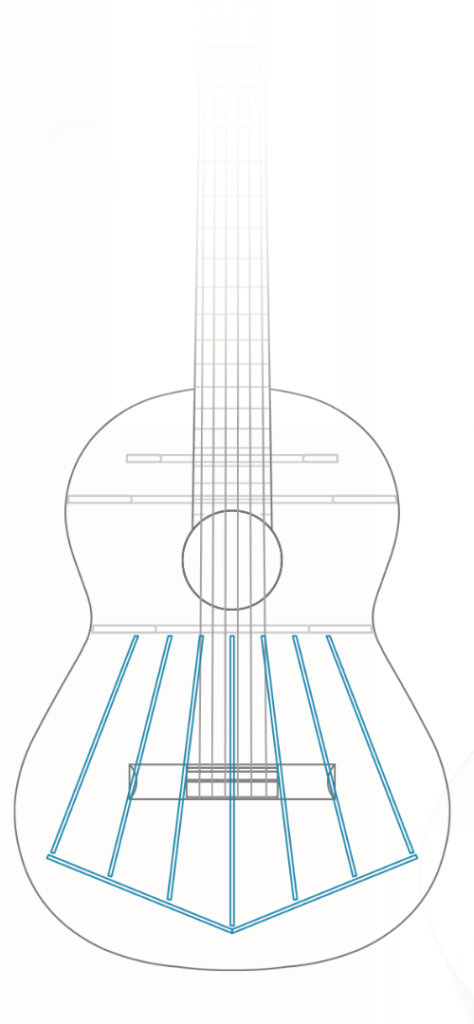
Torres increased the size of the guitar’s soundboard, which allowed for greater volume and sound projection.
Introduced a new H-shaped internal bracing system, known as fan bracing, which improved the structural strength of the soundboard and better distributed vibrations, resulting in a more balanced and powerful sound.
Torres paid special attention to the construction of the soundboard, using high quality woods and refining its thickness to optimize resonance.
He innovated in the construction of the neck, making it lighter and thus improving the comfort and balance of the instrument.
He standardized the shape and size of the guitar, establishing the dimensions and proportions that are considered standard in the modern classical guitar.
Torres’ innovations were adopted by later luthiers around the world. His designs became the model for classical guitar construction. Not only is he a reference in luthiery, but he has become a guitarist’s dream.
As mentioned beffore, the classical guitar is characterized by having a higher string action, and by being made with imported woods.
The main woods are Maple from Canada or Rosewood from Rio de Brazil. We can also find Cuban Mahogany, but it is not so common.
Both woods were very difficult to acquire, both for the transportation and the quantity of wood, which made the price of the guitars more expensive.
Nowadays, due to changes in the ecosystem, woods such as: Indian or Madagascar Rosewood, Ciricote, Cocobolo, and others are used.